
City break inDresden
Dresden, the capital of Saxony, is one of Germany’s most visually striking city-break destinations, set along the River Elbe and framed by gentle hills. The historic center is compact and easy to explore on foot, with landmark sights clustered around the Theaterplatz and Neumarkt. The rebuilt Frauenkirche has become a symbol of the city’s post-war recovery, while the Zwinger palace complex and the Semperoper highlight Dresden’s long-standing role as a center for art and music.
Across the river, the Neustadt district adds a contrasting, lived-in feel with Gründerzeit streets, small galleries, and a strong café and bar scene. Museums are a major draw: the Old Masters Picture Gallery, the Green Vault, and the Albertinum can fill several days without feeling repetitive. With efficient trams, river promenades, and frequent viewpoints over the Elbe, Dresden works well for a focused weekend or a longer cultural trip.
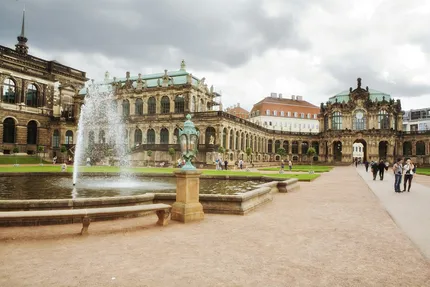
Zwinger Palace
The Zwinger is a major Baroque palace complex in central Dresden, built in the early 18th century under Augustus the Strong. It features an ornate courtyard, pavilions, and galleries, including the Old Masters Picture Gallery, the Porcelain Collection, and the Royal Cabinet of Mathematical and Physical Instruments. Visitors come for architecture, museums, and views from the walls.
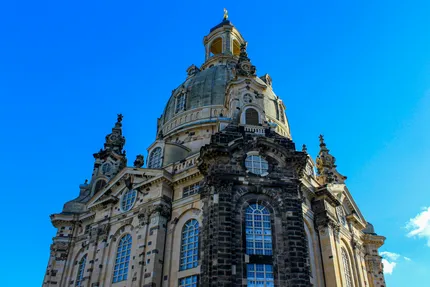
Frauenkirche Dresden
The Frauenkirche is a landmark Lutheran church in Dresden’s Neumarkt, rebuilt after its wartime destruction and reconsecrated in 2005. Visitors can see the baroque interior and the preserved dark stones from the original ruins. The church often hosts services and concerts. A climb to the dome viewing platform offers panoramic views over the old town.
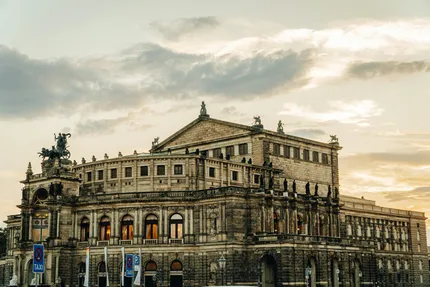
Semper Opera House
The Semper Opera House (Semperoper) is Dresden’s historic opera venue on Theaterplatz, rebuilt after WWII and reopened in 1985. It hosts opera, ballet, and concerts by the Saxon State Opera and Staatskapelle Dresden. Visitors can join guided tours to see the ornate auditorium and learn about its architecture and history.
Dresden Castle
Dresden Castle (Residenzschloss) is a major historic complex in Dresden’s old town and former residence of Saxon electors and kings. Rebuilt after heavy WWII damage, it now houses several museums, including the Green Vault treasury, the Armory, and the Turkish Chamber. Visitors can explore restored rooms and courtyards and climb the Hausmannsturm tower.
Pillnitz Castle and Park
Pillnitz Castle and Park lies on the Elbe River in Dresden and is known for its Baroque and Chinoiserie-style palace buildings, including the Riverside and Upper Palaces. The landscaped park features gardens, pavilions, and notable botanical specimens such as the historic camellia. Visitors can tour museum rooms, walk riverside paths, and explore seasonal exhibitions.
Brühl's Terrace
Brühl’s Terrace is a historic promenade along the Elbe River in Dresden’s old town, often called the “Balcony of Europe.” It runs above the riverbank near key landmarks such as the Albertinum and the Academy of Fine Arts. Visitors come for river views, architecture, and easy access to nearby museums and squares.
Albertinum
The Albertinum is a major art museum in Dresden, located in a former armory near the Brühl Terrace. It houses the Galerie Neue Meister (19th–20th century painting) and the Skulpturensammlung (sculpture from antiquity to the present). After severe 2002 flood damage, it reopened with redesigned, flood-protected collection storage and galleries.
Dresden Transport Museum
The Dresden Transport Museum (Verkehrsmuseum Dresden) is located in the Johanneum on Neumarkt, near the Frauenkirche. It presents the history of transport in Saxony and beyond, with exhibitions on railways, road vehicles, shipping, and aviation. Displays include historic locomotives, cars, bicycles, and model railways, with family-friendly interactive elements.
Kunsthofpassage
Kunsthofpassage is a set of interconnected courtyards in Dresden’s Neustadt district, known for creative building facades and small shops, cafés, and studios. The best-known courtyard features the “Singing Drain Pipes” installation, where rainwater can create sounds. It’s free to enter and easy to visit on foot while exploring Neustadt.
Military History Museum
The Bundeswehr Military History Museum (Militärhistorisches Museum der Bundeswehr) in Dresden explores German and European military history and its social impacts. Housed in a former arsenal, it features a striking modern wedge-shaped extension by architect Daniel Libeskind. Exhibits include weapons, uniforms, vehicles, and thematic galleries on war, violence, and memory, with extensive interpretive displays.
Who should visit Dresden
Dresden is an excellent short-break choice for culture-focused travellers who want high-quality museums and architecture in a manageable, walkable setting. It suits art lovers and history enthusiasts who plan their days around collections such as the Green Vault, Old Masters, and the Residenzschloss, and who appreciate the city’s layered story of destruction and reconstruction. Classical music and opera fans are a strong target group as well, since the Semperoper and nearby venues make it easy to build an evening around a performance (booking ahead is wise).
Couples and small groups looking for a scenic, relaxed city trip will enjoy the Elbe terraces, river views, and the contrast between the Baroque old town and the more alternative Neustadt for dining and nightlife. Dresden also fits travellers who like structured sightseeing without needing a car: trams connect key districts efficiently, and day trips to Saxon Switzerland’s viewpoints and trails are straightforward by S-Bahn and bus.
It is less ideal for travellers seeking a fast-paced clubbing destination or extensive big-city shopping, but it excels as a compact, museum-rich, visually impressive weekend city.

Best time to visit Dresden
Late spring (May to June) and early autumn (September to early October) are the best times to visit Dresden. Days are usually mild, the Elbe riverbanks are pleasant for walking, and major sights are less crowded than in peak summer. July and August bring warmer weather and longer evenings, but also higher visitor numbers and more limited availability for popular performances and museum time slots. December is attractive for its Christmas markets, especially around the Striezelmarkt, but expect cold temperatures and short daylight hours. Winter outside the festive period can be quiet and good for museums, though weather is often grey and damp.
Three top reasons for a city trip to Dresden
- Marvel at Dresden’s rebuilt Baroque skyline: the Frauenkirche’s dome, Zwinger Palace courtyards, and Semperoper. The compact Altstadt lets you walk between masterpieces, river views, and ornate squares.
- Explore world-class museums: Raphael’s “Sistine Madonna” at the Gemäldegalerie Alte Meister, the Green Vault’s jeweled treasures in the Residenzschloss, and the Albertinum’s modern art beside the Elbe.
- Enjoy the Elbe River setting: stroll Brühl’s Terrace, cross Augustus Bridge at sunset, and take a steamboat to Pillnitz Palace gardens or Saxon Switzerland’s sandstone cliffs near Dresden.
Dresden is a city that offers an efficient public transportation system, predominantly consisting of trams and buses operated by the Dresdner Verkehrsbetriebe (DVB). This network is well-connected and allows for convenient travel across the city and to its outskirts. Additionally, Dresden is quite pedestrian-friendly, with most of its attractions easily accessible on foot in the city center, known as the Altstadt. For those who prefer cycling, the city also offers bike rentals and dedicated cycling paths, making it a reasonable option for getting around. While a car is not necessary for navigating the central areas, having one can be useful for exploring the surrounding Saxony countryside or other nearby cities. Overall, public transport, walking, and cycling are the preferred modes for getting around Dresden efficiently.
This content was created with AI assistance and may contain inaccuracies.